How does a CD Burner work?
How does the home CD burner differ?
Its obviously impractical to get such a technique as they use on the production line
into the home PC. Another solution had to found in order to get CD writing technology
into the home. The idea that they came up with was to actually change what the CD was
made of. The technology of the laser reflecting off the disc was still there however
this time the aluminium layer was totally flat.
Instead of covering the bumps in the track like in the production model. What we have
on the common CD-R now is a layer of dye. This dye is translucent and so the laser beam
will go straight through it and reflect off the aluminium surface and into the optical
sensor. Its the same all the way round the disc, this is how you receive your blank CD-R's.
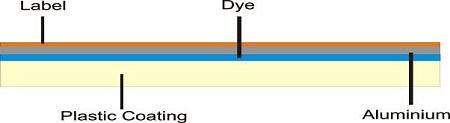
When writing to a CD-R a higher powered laser is used than that of the standard
reading laser. This laser is set at a particular frequency and when it comes into
contact with the dye its turns it opaque (to a state where the light can't pass through
it. To the optical sensor this is the same as the laser beam bouncing off the bump of
the production CD as it simply does not get the signal back. The physical shape of the
material on the CDR does not change as you can see from the above diagram, but still
the effect is permanent which brings us onto the next point. re-writable storage CD's.
Now known as CD-RW's.
So how does a CD-RW work?
If we now move onto CD-RW's we take a big step forward in the CD storage media's
technology. The CD-RW is a lot more complex than the standard CDR (some say a little
less reliable, although I personally have not had problems with CD-RW's). The problem
obviously comes with the fact that the data on the disc can not be permanent. This
means the production style burning and the original home style burning can't be used
on a CD-RW. Lets have a quick look at the way a CD-RW is put together.
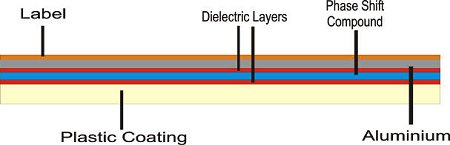
The CD-RW uses phase shift technology, using a specially created phase shift compound.
The idea behind this is that with this compound the laser can heat it up to melting
point at which point the compound turn opaque and the read laser would not be able to
bounce back a signal. this then turns into an amorphous state (no crystalline form).
It will cool this way and be opaque until its reheated.
| 

 About BTH
 User Agreement
 Privacy
 Site Map
 Contact
 News Feeds


 RSS Feed
 Follow @Stephen Bucaro
 Windows Troubleshooting


