The Windows Indexing Service has to continuously monitor the files on your computer for changes and update it's database when changes or new files are found. This uses processor time and can take up more than a megabyte of ram. If you're just you're sitting in front of your computer and the hard drive starts working very hard, that's probably the Indexing Service.
Welcome to Bucaro TecHelp!

Welcome to Bucaro TecHelp!
Maintain Your Computer and Use it More Effectively
to Design a Web Site and Make Money on the Web

[About BTH]  [User Agreement]  [Privacy Policy]  [Site Map]  [Contact]  [Advertise on BTH]  RSS News Feeds  News Feeds


Disable Indexing to Speed Up Your Computer

When you perform a search on Windows Vista, you can actually search the "contents" of files. Searching files is a very slow process, but Windows can produce the results in seconds. How is this possible? It's possible because Windows keeps a database, called an "index", of all the files on your computer. It's great to get results quickly, but there's a price to pay.

The service that creates the index, called the "Indexing Service", has to continuously monitor the files on your computer for changes and update it's database when changes or new files are found. This uses processor time and can take up more than a megabyte of ram. You may notice when just you're sitting in front of your computer, not executing programs or saving files that the hard drive starts working very hard. That might be the Indexing Service working to update it's database.

If you commonly search only ceratin folders, you can reduce the amount of work performed by the Indexing Service by configuring the indexing options. Select Control Panel | System and Maintenance | Indexing Options and in the "Indexing Options" dialog box remove any folders that you rarely search from the index.

If you rarely use Windows Search feature, and you find it anoying to hear your hard drive working very hard when you're not performing any drive intensive tasks, you can disable the Indexing Service. To disable Indexing Service, Select Control Panel | System and Maintenance | Administrative Tools | Services.

If the User Account Control dialog box appears, click on the [Continue] button.
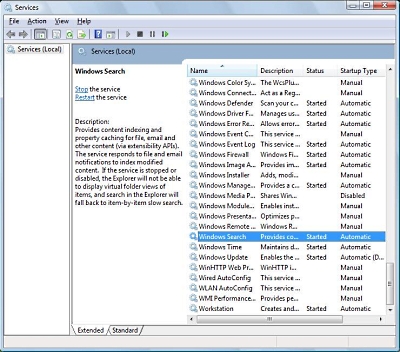
Services window

In the Services window that appears, scroll down to, and right-click on Windows Search. In the popu-up menu that appears, select Properties.
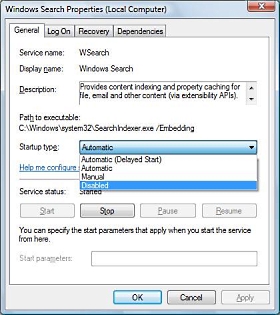
Services window

In the Windows Search Propeties dialog box that appears, in the Startup type: dropdown list, select Disabled. Then under Service status, click on the [Stop] button. When the Service status indicates Stopped, click on the [OK] button to close the dialog box.

With the Indexing Service stopped, you can still search just the same as always, except Windows Search has to build an index, in real time, of the folder(s) you select to search, so receiving results may take longer than if the Indexing Service had been running.

Computer Sections

RSS Feed RSS Feed

Google Reader or Homepage
Add to My Yahoo!
Subscribe with Bloglines

Add to My AOL
Add to Technorati Favorites!

Windows System Administration
Tweaks to Speed Up Internet Streaming Video
Create and Change Password, Picture and User Name in Windows 7
Set Up Parental Controls
Video - Microsoft Remote Desktop - Part One
Video - Microsoft Remote Desktop - Part Two
What is Windows Aero and Mouse Gestures?
Easy PC to PC Files and Settings Transfer Cable
Introduction to DOS
DOS Switches and Wild Cards
Installing a Local Printer on Windows Vista
Installing a Network Printer on Windows XP and Vista
SMART Disk Drives Warn You Before They Fail
Is Your Critical PC Data Adequately Protected From Disaster?
Security Risks and Ways to Decrease Vulnerabilities in a 802.11b Wireless Environment
Configure Vista's Data Execution Prevention
How to Backup Mails and Address Book of Outlook Express
Windows 2000 Security Overview
Kill The Messenger (Service)
Use the HOSTS File to Block Web Sites
FreeDOS
A Day in the Life of a System Administrator
Microsoft Licensing Explained
Windows PC Performance Troubleshooting and Optimisation
Restrict Web Browsing With Internet Explorer
Internet Connection Sharing in Windows XP
Turn Off Windows XP Service Pack 2 Firewall
Guide To Setting Up Dual Monitors
Windows 7 Tweaks
Hands-On Microsoft Windows Server 2008 Administration
Disable Indexing to Speed Up Your Computer
Configure Windows Indexing Service for Performance
Configuring Windows as a NTP (Network Time Protocol) Server
Font Basics
Three Important Techniques for Securing a Wireless Network
Defend Your Business with a Firewall
Msconfig - Microsoft's Secret Weapon to Increase Your Computer's Speed
Choosing a Tape Drive
Video - How to Remove the Bloat from Your PC
Create a Windows 7 System Repair Disc
Video Tutorial 1 - The Windows 7 Backup and Restore Utility
Video Tutorial 2 - The Windows 7 Backup and Restore Utility
Video Tutorial 3 - The Windows 7 Backup and Restore Utility
Computer Data Backups - Test Now or Cry Later
PC Technician Certifications and Professional Organizations
PC Technician's Guide to Providing Telephone Support
PC Technician's Software Copyright Responsibilities
CompTIA A+ Complete Study Guide
Hard Disk Management
Windows Server 2003 Active Directory and Network Infrastructure
The Security and Maintenance of Messages in Outlook Express
Planning a Backup and Restoration of Files for Disaster Recovery
WSH to Master Your Computer
Script to Print a Directory File List
Disable Long Filenames to Improve Window's Performance
Disable Kernal Paging to Speed Up Windows
Script to Display the Processes Running on a Computer
Script to Identify Your Systems HAL
To Protect Your PC Disable the Windows Scripting Host

TigerDirect

[Site User Agreement]  [Advertise on This site]  [Search This Site]  [Contact Form]
Copyright©2001-2010 Bucaro TecHelp P.O.Box 18952 Fountain Hills, AZ 85269